4/29/09
WILD HONEY by VIRGIL, c.30 BC
Leonardo 4/29/09
4/27/09
Next Bee Meeting - Sunday, May 3rd
Hey all -
Next Backwards Beekeepers meeting will be at 11am this Sunday, May 3rd. Kirk is going to talk about what to do once you get your bees and how to deal with those pesky ANTS.
Join the Yahoo Group (link is on the right side of the blog) to get all of the location info.
Looking forward to seeing everyone on Sunday!
BUGS: The Sequel
The ants go marching...
The cinnamon worked for me, for a while, but it got used up quickly and I think the ants get immune to it anyway. Now I have switched to diatomaceous earth (I got it in a 1.5 lb. box at the nursery, about $8,) which I sprinkled (OK, heaped) around the bottom edge of my support box, as well as smearing some on the as-yet-unfilled-by-propolis cracks in the hive itself. That seems to be working for the moment, as long as I am diligent about re-application.
When I do my next inspection, I am going to try to nail some legs on my support box and put them in bowls of water or oil, as has been suggested by others.
I am resigned to the fact that there are a bazillion ants in my garden. I was feeling regretful about trapping that possum who was digging pits in my strawberry beds, 'cause the uneaten ants had migrated to the hive, but now the trenches are back, worse than ever. I figure the ants must taste really good, since their little bellies are full of honey (?), but I have worked so hard on my strawberries.....so I gotta get the trap out again, repair the part of it that was chewed by the possum, and reset it.
I feel a little like I'm caught up in some kind of wild Circle of Life here. Sheesh.
Labels: dealing with ants
4/25/09
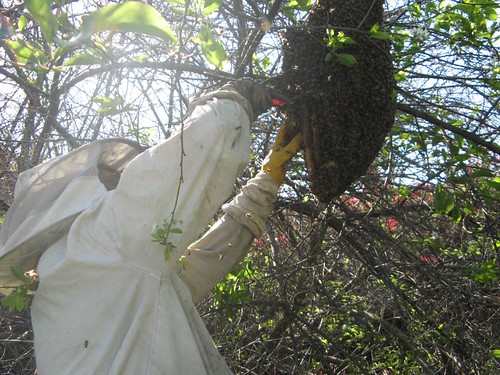
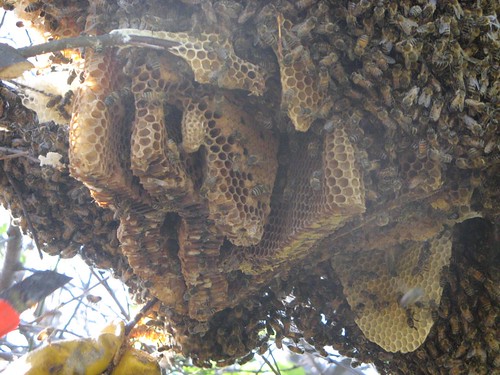
Neighborhood bee hive
Here's a great story from Kirk about why a live-and-let-live approach is sometimes the best solution. Today we're in Whittier, California.

(These are two views of the same hive.)
Kirk follows up:
Hay guys the bees in the tree. That is a hive not a Swarm. When they are out in the open like that the bees cover the whole hive(combs). Pretty neat to see.
Russell 4/25/09
4/23/09
Bees for Fernando
Remember the bees in a can? They have a home now.
And check out Fernando's DIY beekeeper gear! Much respect.
Kirk tells the story:

Russell 4/23/09
4/22/09
Backlog, March 28th: How I got my bees
Kirko and I went to a house in Marina del Rey and did a cut out. Er, well, he did a cut out and I tried to be as helpful as possible. It was a huge hive, with about 65,000 bees. They were surprisingly docile and though a few did find their way up my pants and started crawling around my legs, neither of us got stung during the removal.
For reference, Kirko is about 6'2" or so.
Kirk originally thought we'd need a lot more hive boxes for this than the three I had, since there were so many bees. But recently he went to a bee conference, and he met a guy who didn't bother taking the comb with him, just the bees. For this guy's method, you need a couple frames of brood, and the queen, but you don't need all the comb that has been drawn. We decided to give it a try.
Smoking the hive. We've already cut into it a bit, but you should smoke periodically to keep the bees mellow.
Here is the underside of cut up hive.
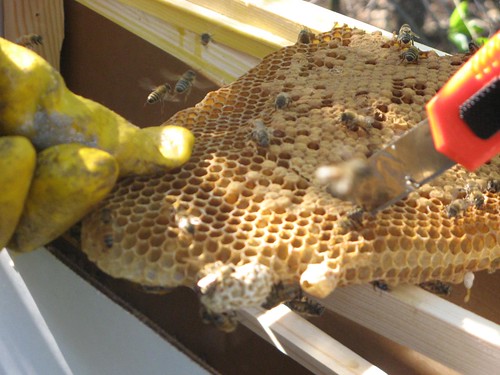
Here is Kirko cutting some comb with brood down to fit the frame.
And no, he doesn't seem particularly worried about slicing through some of the capped brood.

After we fit the comb to the frame, we tie it in. The bees glue it back in with more wax, and then get rid of the string.
Within about an hour and a half, we finished cutting out the hive and shaking the bees into their new home. From the behavior of the bees in the hive box, we were pretty sure we had the all-important queen.
Some of the bees from the cut out had fallen and were hanging out on the ground, a little disoriented and unsure where to go, since we had changed the location of their hive. Some of the bees in the hive box eventually stuck out their hineys and started fanning out their pheremones telling the outside bees where home was. Another good sign that we had the queen.
Eventually as many bees as we were willing to wait for made their slow way towards the hive. Those that were left just had to fend for themselves. Hopefully they will find a hive to take them in.
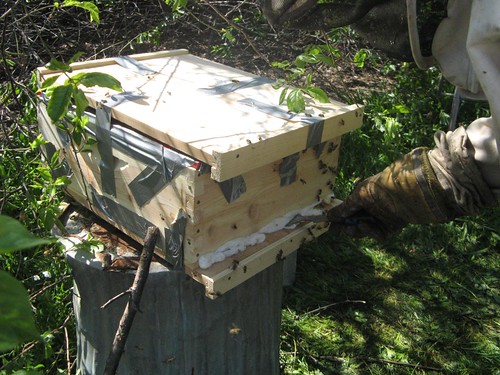
In order to prepare the hive box for transport, we taped a screen to the top, and then the top board on top of that, with a gap to let in air. The screen was meant to keep the bees from flying out. We also stuffed the entrance of the hive with cheesecloth, but then decided they had enough air through the top screen, and also taped up the entrance.
We cleaned up, and loaded the hive box into the back of my car. It seemed pretty safe, with everything taped up, but Kirko advised that I keep my veil on just in case. It was a good idea, since we did see a few bees flying out as we drove along the freeway, and Kirk got stung on his hand during the ride!
But all in all, we made it to our destination intact, safe and sound. Funny that it should be in my old stomping grounds by my alma mater. Kirko had found an old theatre in the West Adams district when a couple ladies called him to get a hive of bees out of a pedestal in their garden. But though they didn't want a hive in their pedestal, they were more than happy to host a hive elsewhere in their garden.
Enter, moi!
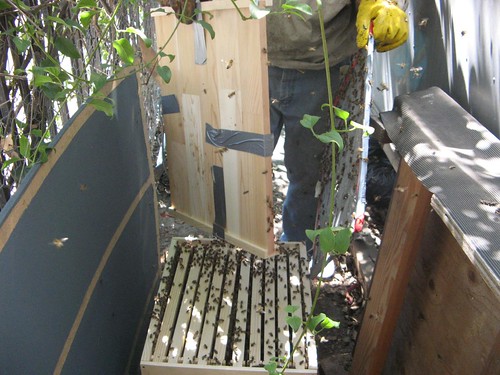
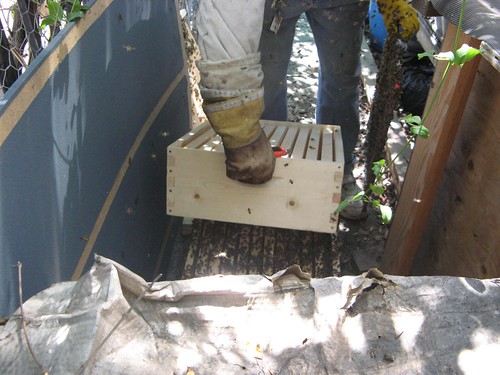
Here is Kirko setting them up behind Jade's airstream. He's taken off the top screen and top board.
We decided to add another hive box, just because there were so many bees that we figured they'd draw comb pretty quickly. We didn't want them to swarm for lack of space in the meanwhile.
There is always a chance that the bees will abscond when they are taken from one location to another. Usually they won't leave brood behind, but you never know. However, if they are still there within six to eight hours later, there's a really good chance they will stay for good.
Well, a month later, and so far so good. They've drawn a few frames of comb and seem to be pretty happy, as far as I can tell. I'm still feeding them sugar water, and will probably do a full hive check this weekend.
Pshaz 4/22/09
Mr. Ando of the Woods
An English-subtitled version of Takashi Taniguchi’s “Mr. Ando of the Woods," starring a hungry man-bear and a stingy bee.
4/21/09
Crushing and Straining in Torrance
This was a honey filled weekend.
Equipment used in this operation was: a 5 gallon bucket/lid filled with honey comb, 5 gallon honeybucket with honey gate, pestle, 18" X 12" cooking pan, flexible cutting board, rubber spatula, 600 micron filter and assorted jars. The honey bucket was purchased at Los Angeles Honey. The filter I bought from Dadant & Sons online for $5. This filter fits right on top of the bucket, and is easily washable and reusable.
I had a lot of fun doing this. The yield was about a gallon and a half or 14lbs of delicious chemical free honey. We don't have any fancy labels or clever name for our honey yet. Although my wife Christine came up with a possible name for Eric's honey "Ramshackle Liquid".
Did I forget to mention that backwards is the new forwards?
Steve R 4/21/09
Labels: honey harvesting
4/20/09
Viewer mail
When you buy packaged bees by mail, the queen arrives in her own cage. Here's what a queen cage looks like, courtesy of beegirl211 on Flickr:
...which brings us to today's Viewer Mail:
I am a lay bee keeper and have just installed a package of bees in a hive, I looked in the queen wooden block with candy plug and they all looked the same to me, I did not recognize the queen and have some doubts, my question; what are the signs that I should look for that the queen is actually present well and active, and how long after hiving should the signs appear.
Thank you so much
Dempsey
Here's Kirkobeeo's answer:
Russell 4/20/09
Labels: viewer mail
4/19/09
4/18/09
Trap-out, illustrated.
Here's a great step-by-step look at a trap-out, from a job that Kirk and Sebastian did today. In this example, the bees are living in the wall of a house.
Step 1: Seal all the available bee entrances/exits (except for a single small one) with caulk.
Step 2: Install a one-way bee escape (the bees can get out, but not back in) over the remaining hole leading to the hive.
Step 3: Install a bracket to hold a nuc box.
Step 4: Place the nuc box with the entrance as close as possible to the bee escape. This nuc box contains brood, pollen, bees, and a queen. The bees from the wall hive, unable to return home, will join the nuc box hive. The nuc box population can grow fast—it can sometimes take several nuc boxes to collect all the bees from a trap-out hive.
Here's Kirk's play-by-play:
Here's another trap-out in action:

4/17/09
The Bees are Buzzing in the Trees

Speaking of swarm season, I was driving through Beverly Hills this afternoon when I noticed a bunch of people on the corner of Wilshire & La Cienega flapping around and slapping themselves. A couple of bees flew into my windshield and I pulled over to assess.
There were quite a lot of bees and they were right in front of a bank. I spoke to the bank manager and gave him the contact info for Martha from the Backyard Beekeepers, as Kirk had already captured 4 swarms today and was maxed out.
I took some pictures before I left too. Vivan las abejas!
Amy 4/17/09
Did we mention that it's swarm season?
Kirk and Sebastian encountered many, many thousands of bees today.
Check out Kirk's description here, and the photos below:


Labels: swarm capture
+ resources
A friend sent me a link to BackYardHive, a website chock-full of info and resources for backyard beekeepers. It originates in Eldorado Springs, CO.
Also, check out this great little book, "Towards saving the Honeybee".
"Saving the world one bee at the time"
4/16/09
Now that we have bees, we want more bees.
4/15/09
Bees with chompers
Kirk has some feisty bees in a trap-out he's doing.

He says:
These bees keep chewing through the cardboard around the bee escape. I used tinfoil this time with caulk—that should help out.
I've taken bees out of this porch before. A swarm moved back in so I'm trapping them out. They will join the hive sitting you see in the picture. I added another box, thinking of the 10,000 bees that will be coming out of that porch soon.
Here's more of the story:
Russell 4/15/09
Let's Bee Friends

We got a really nice link on the Pollinate This! blog. It is a thorough and informative bee site with a ton of links and resources.
I've added a link to Pollinate This! in our "Blog Friends" list (in the right-side column of this here blog) for your continued reading pleasure. It's worth checking out.
4/14/09
Bees in a can, and other adventures.

You just never know what sort of bee residence Kirk is going to find next. Today it was a paint thinner can, which appears to have housed these bees for several years or more.
Here's the story:
Russell 4/14/09
4/13/09
Viewer mail
Hello,
I happened onto your blog while searching online for some information about bees.
I live in the Highland Park area of Los Angeles. I am an avid gardener and thus pay pretty close attention to what’s going on in and around my yard.
From time to time I find a dead or dying honeybee in my driveway, or back yard, or somewhere around the place. I would say that in the summer there might be as many as one a week, at the most.
I doubt anyone around here is using bad chemicals on their property, as weeds are more the norm, and few of my neighbors really seem to garden or care much about their outdoor space per se.
Is there anyone studying this phenomenon? I read from time to time that bees are having a hard time these days and was wondering if I should be sending the dead bees to someone who might want to have a look at them for research purposes.
Best regards,
Earl
Kirkobeeo responds:
Russell 4/13/09
Labels: viewer mail
4/12/09
Beekeepers Helping Beekeepers

Sue sent this post to the Yahoo Group and David answered it so well that we thought it should be shared with everyone.
Sue Said:
Ants.
Big time.
I did the cinnamon thing and have all my fingers and toes crossed that my bees don't freak out about the little black buggers and fly away before I get them in my hive on Sunday.
I'm having an anxiety attack, but I promised I wouldn't open that box....
I trapped a possum a couple of days ago and turned it loose in the wilds of Elysian Park, and now I feel a little guilty because possums and skunks eat ants. But they tear up my garden in the process, and the thing possums do to chickens is unspeakably gross, so i guess it's a trade-off.
Sue
David replied:
Hello Sue,
I was at Glendale library reading some bee books that suggested besides poisons, putting hive on blocks/legs & the blocks/legs w/ oil or water pans under, to moat the hive. Also a sticky product called tanglefoot is said to keep ants at bay for a while. I tried cinnamon & ants marched through it, orange oil didn't seem to work also. That recent cutout w/ queen mighta departed for other reasons but I will try a water or vege oil moat next time to keep pesky ants away.
Kirk's suggestion of not including the honey comb in the cutout was taken to heart as my first ever cutout was attracting oodles of ants. Good luck on your hive, I know it will be a success as BeeKeeper Kirk is guiding you :). Can't wait to hear the group minds innovative ant deterrent methods.
Mentioning unspeakably gross, dachshunds do unspeakably feral things to opossums, even the mini dachshunds. My roto tillers au natural, aka possum/ skunks going to town as well in the garden so had to fence some beds.
Cheers, David
Nice one David! Dennis also suggested Diatomaceous Earth as an ant deterrent in a subsequent post, which could be a great solution as well.
Amy 4/12/09
School for beekeepers

Kirk gave a great beekeeping class today at Sue and Liebe's beautiful place in Silver Lake.
A few people were lucky enough to leave with fresh eggs from the resident chickens.
Kirk and Sue opened up the nuc box where Sue's bees have been living and found plenty of brood, meaning that the queen is doing her thing and the hive is happy. They loaded the bees into Sue's finished hive boxes, which led to a few airborne attacks.
Curtis even caught a sting in the mouth(!), but like any good beekeeper he was a total tough guy about it.
Keep an eye on our Yahoo Group page for information about the next class.
Here's Kirk's message for today, which includes a story about a bee misadventure he had this afternoon: